
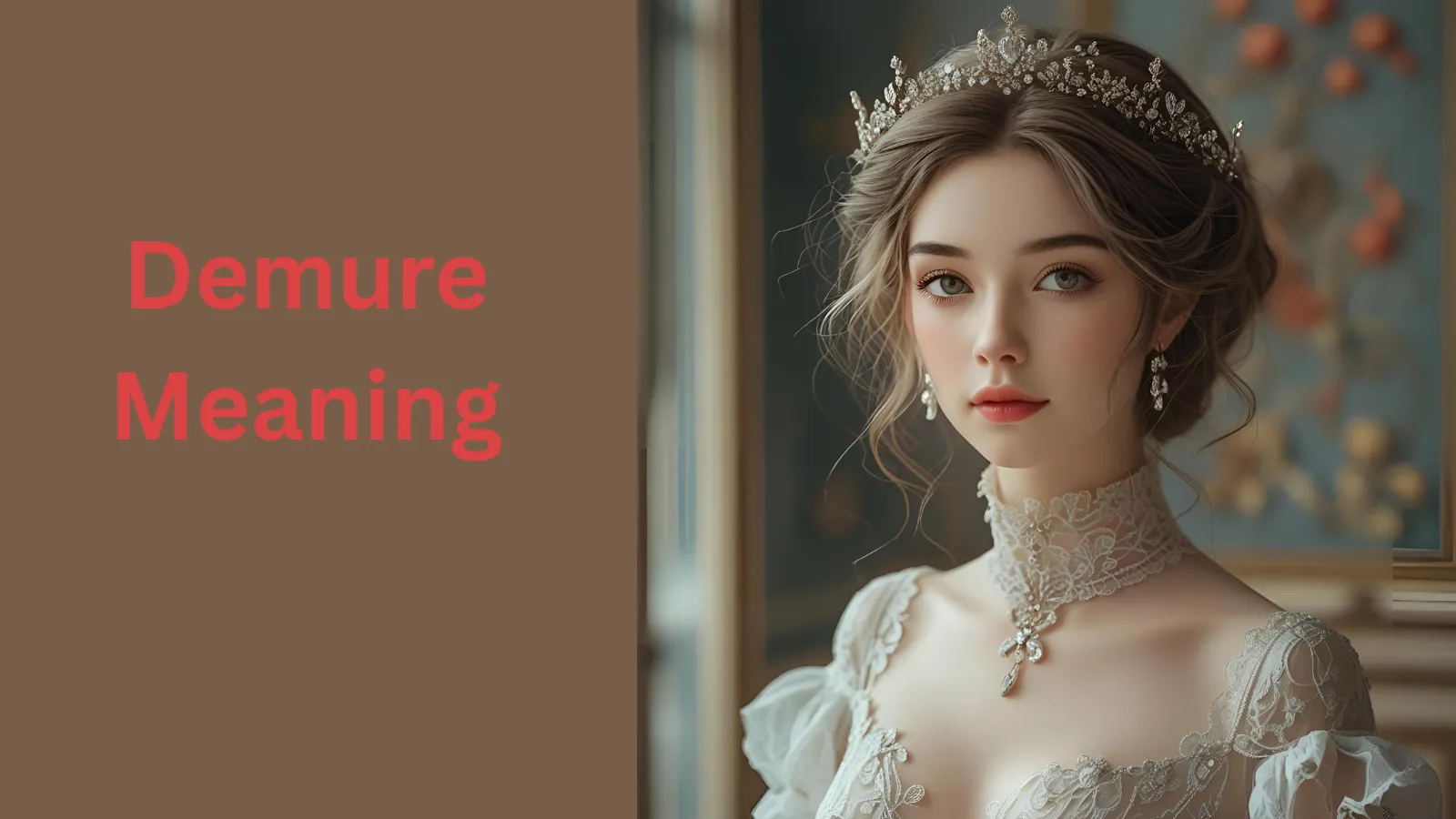

Demure Meaning reveals the subtle elegance and quiet charm behind modest and reserved behavior. Demure means being modest, reserved, or shy in behavior, appearance, or manner. It often describes someone who is quietly elegant, polite, and unassuming, creating a sense of subtle charm. For example, you might say, “She gave a demure smile at the compliment,” or “His sister’s demure demeanor impressed everyone at the gathering.”
In this article, we’ll explore the meaning of demure, look at its origins, provide real-life examples, and share synonyms and related expressions.
By the end, you’ll understand how to use “demure” accurately and effectively in everyday conversations and writing.
What Does “Demure” Mean?
Demure describes someone modest, reserved, or shy, often in a way that is polite and subtly attractive. It highlights a calm and composed demeanor, typically avoiding attention or bold behavior. While commonly used for personality traits, “demure” can also describe appearance or mannerisms that are understated yet elegant.
Example Sentences:
- “She gave a demure smile when praised for her artwork.”
- “His demure posture made him seem approachable and kind.”
- “The actress wore a demure dress that perfectly matched her graceful personality.”

Key Points to Remember:
- Demure emphasizes modesty, quietness, and subtle elegance.
- It is often used in formal or polite contexts, but can also describe casual behavior.
- Being demure is not about weakness, but about poise, restraint, and understated charm.
Background: Origins and Evolution
The word demure dates back to the late Middle Ages. Derived from Old French demore or demeure, meaning “to stay” or “to remain,” it evolved into an English term used to describe modesty or reserve.
In historical literature, particularly during the Victorian era, “demure” was regarded as a desirable trait in women. A demure woman was seen as virtuous, proper, and respectful. Over time, however, feminist critique questioned this ideal, arguing that the label often reinforced gender stereotypes and suppressed assertiveness.
In modern language, while the word has largely maintained its core meaning, it’s taken on layers. It can now also imply subtle confidence, sophistication, or even strategic restraint.
Usage in Different Contexts
The way demure is used can vary based on the platform or setting.
1. Everyday Speech
You might hear someone say:
“She wore a demure dress to the ceremony.”
Here, it emphasizes tasteful modesty and elegance.
Professional Settings
In corporate feedback, someone might be described as demure to indicate a soft-spoken but capable individual. While this may highlight humility, it can also be seen as lacking assertiveness if not contextualized properly.
Fashion & Design
A fashion line may promote “demure styles” that avoid bold prints or revealing cuts, focusing instead on subtle beauty.

Chat, WhatsApp, Instagram & TikTok
On digital platforms, especially among Gen Z and Millennials, “demure” shows up in both captions and comments.
WhatsApp/Chat
“You looked so demure at the party last night 😍”
Used as a compliment—hinting at charm, elegance, and softness.
Captions like:
“Serving demure vibes today 💅👗”
This reflects a fashion or mood post showcasing minimalism, modesty, or vintage-inspired elegance.
TikTok
Creators may use “demure” in transformations:
“From baddie to demure in 60 seconds”
Here, it’s about shifting from bold to subtle aesthetics.
In online slang, “demure” often has a playful twist. It can imply intentional modesty for effect, making it both traditional and trendy.
Physics, Medical, and Aircraft Terminology
Interestingly, demure is rarely used in technical fields like physics, medicine, or aeronautics, because it’s not a scientific term. However, it may occasionally appear in descriptive narratives or documentation in these fields.
For example:
- In medical case reporting, a patient might be described as having a “demure demeanor,” meaning they present themselves modestly or reservedly during consultations.
- In aviation, you might read a pilot’s profile referring to their “demure approach” in handling pressure, highlighting calmness and self-control.
In these examples, “demure” retains its core meaning but is used to describe attitude rather than data.
Common Misconceptions
Many people misunderstand or misuse the term “demure” due to its nuanced tone.
Misconception 1: Demure equals weak.
Not true. Being demure doesn’t imply weakness—it can indicate quiet strength, restraint, or self-confidence.
Misconception 2: Only women can be demure.
While often used to describe women, the term can apply to anyone whose demeanor is modest or reserved.
Misconception 3: Demure means boring.
Quite the opposite. A demure personality can be intriguing, deep, and even mysterious.
Similar Terms & Alternatives
Here are words similar in tone or usage to “demure”:
| Word | Difference |
|---|---|
| Modest | Focuses more on humility, especially about achievements. |
| Shy | More about social anxiety or fear. |
| Reserved | Suggests holding back emotionally or socially. |
| Meek | Often implies submission or lack of assertiveness. |
| Elegant | Emphasizes refined grace more than shyness. |
Alternative Phrases:
- “Soft-spoken charm”
- “Graceful restraint”
- “Subtle poise”
How to Respond to Demure
If someone calls you demure, consider their tone and intention.
If it feels like a compliment:
“Thank you, I appreciate your kind words.”
When it feels patronizing:
“Interesting perspective—I see myself as confident in a quieter way.”
You can own the word or redefine it for yourself. There’s power in being poised without being loud.
Differences from Similar Words
Let’s break down the differences more clearly:
| Word | Demure | Reserved | Shy |
|---|---|---|---|
| Definition | Modestly composed | Emotionally cautious | Nervous in social settings |
| Emotion | Calm, graceful | Neutral, distant | Anxious, hesitant |
| Gender Bias | Often feminine | Gender-neutral | Gender-neutral |
Key takeaway: Demure is about graceful modesty, while other words may involve fear or emotional distance.
Relevance in Online Conversations & Dating Apps
In dating profiles, the term “demure” shows up as a trait of attraction or a preferred personality type.
Examples:
- “Looking for someone sweet, smart, and demure.”
- “I’m more on the demure side—love quiet nights in.”
It can set expectations about behavior, communication, and even fashion choices. In online chats, being demure can also suggest flirtation through subtlety rather than overt moves.
However, it’s important to balance clarity and nuance—some users may misinterpret “demure” as passive or uninterested if not explained well.
Conclusion:
Being demure isn’t just about shyness or quietness—it’s about grace, elegance, and understated confidence. This trait captures a subtle charm that draws attention without demanding it. From polite gestures to reserved behavior, being demure communicates respect, composure, and refinement in any setting.
Understanding “demure,” its usage, and related expressions allows you to describe people, moments, or behaviors with precision.
Whether in writing, conversation, or storytelling, recognizing the nuances of demure helps you convey elegance and subtlety effortlessly.
