
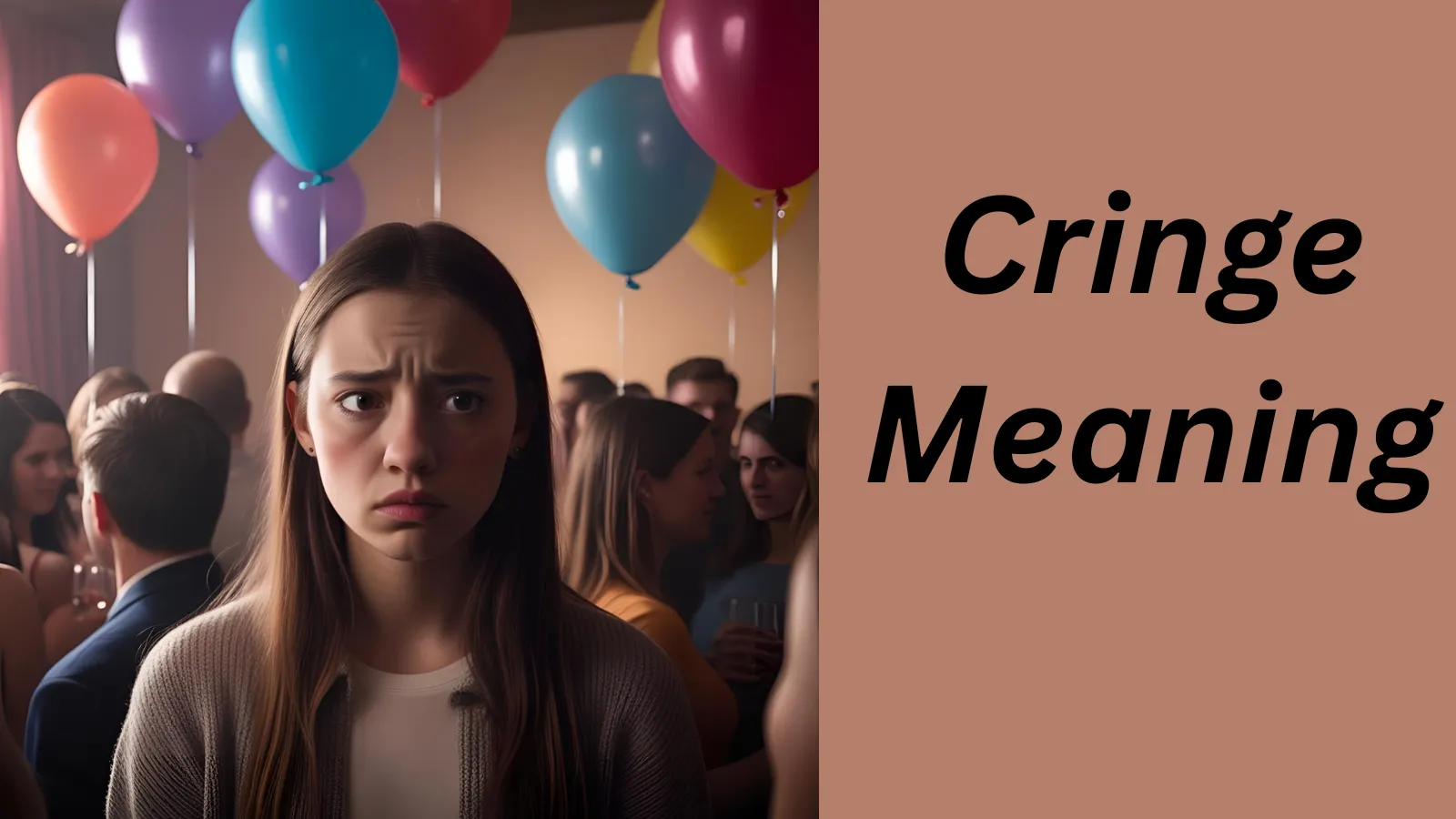

Cringe meaning isn’t just about being awkward — it’s that feeling when something makes you squirm and you can’t look away. Cringe means to feel embarrassed, awkward, or uncomfortable—often because of something awkward, embarrassing, or overly dramatic. You might cringe when you see someone make a social mistake, say something awkward, or act in a way that feels forced or fake. For example:
- “I cringe every time I hear that old recording of myself.”
- “That cheesy love confession made everyone in the room cringe.”
In this article, we’ll break down the meaning of cringe, explore how it’s used in real life and online slang, share example sentences, and explain related expressions so you can use it naturally in any situation.
What Does “Cringe” Mean?
Cringe refers to a strong feeling of secondhand embarrassment or discomfort caused by awkward behavior, speech, or actions. It can describe both the reaction (“I cringe at that”) and the thing that causes it (“That’s so cringe”). The word has become especially popular in internet slang to describe things that feel inauthentic, awkward, or socially uncomfortable.
Example Sentences:
- “I always cringe when I remember my old social media posts.”
- “That fake laugh during the interview was pure cringe.”
Key Points to Remember:
- Cringe expresses discomfort or secondhand embarrassment.
- It’s widely used in internet slang to describe awkward or overly emotional moments.
- “Cringe” can be both a verb (to react) and a noun (the awkward thing itself).
Background & History
The word “cringe” has been around for a long time. Originally, it meant to physically recoil or shrink back in fear or pain. It comes from Old English cringan, meaning “to bend, yield, or fall.”
How Did It Become a Popular Slang?
In recent decades, especially with the rise of the internet and social media, “cringe” has evolved into slang that describes emotional discomfort rather than just a physical reaction. It became a way to express embarrassment for others’ awkwardness or tasteless behavior.
Where Is It Used Today?
- Social media: People label videos, memes, or posts as “cringe” when they find them awkward or embarrassing.
- Gaming: Players might say “that was cringe” after a clumsy move or bad strategy.
- Everyday speech: Friends use it casually to describe awkward moments.
Usage in Various Contexts
The meaning of cringe stays mostly the same, but it appears differently depending on the setting.
Texting & Social Media
- Example:
Person 1: “Just posted my first rap video!”
Person 2: “Wow, that’s kinda cringe, but good try!”
Here, “cringe” can be a light tease or gentle critique.
Gaming
- Example:
Player 1: “I tried to sneak past them but got caught.”
Player 2: “Lol, that was so cringe!”
It’s used to point out a fail or awkward mistake.
Casual Conversation
- Example:
Friend 1: “I tried flirting but said the ignorant thing.”
Friend 2: “Oof, major cringe moment.”
Common Misconceptions & Clarifications
- 1: “Cringe” always means someone is mean or rude.
Clarification: Not always. Sometimes it’s just playful teasing or pointing out awkwardness. - 2: “Cringe” is the only negative.
Clarification: It can be used humorously or affectionately, like saying, “That was so cringe but hilarious.” - 3: Using “cringe” in professional settings is okay.
Clarification: It’s usually too informal and may come off as unprofessional or harsh.
Similar Terms & Alternatives
Here’s a quick look at words related to cringe:
| Term | Meaning | Use Case |
| Awkward | Uncomfortable, uneasy | Formal or casual situations |
| Embarrassing | Causing shame or self-consciousness | Stronger than cringe |
| Cringeworthy | Worthy of causing cringe | Informal can be harsh |
| Cheesy | Silly or overly sentimental | More playful than cringe |
| Used for notably awkward things | Unimpressive or dull | Informal, can be harsh |
How to Respond to This Term
Depending on the setting, you can respond to “cringe” in different ways:
Casual Response
- “Yeah, I know, I totally cringed too!”
Funny Response
- “I’m so cringe, I’m practically a walking meme.”
Professional Response
- “Thanks for the feedback. I’ll work on improving.”
Privacy-Conscious Response
- “I prefer not to comment on that.”
Regional or Cultural Differences
While “cringe” is popular in English-speaking countries like the US, UK, Canada, and Australia, it might not be as common or might have different equivalents elsewhere.
- In some cultures, there might be no direct translation, but people still express similar feelings of embarrassment or awkwardness.
- Regional slang variations include terms like “cringy” (common in the US) or “embarrassing” (more formal).
Comparison with Similar Terms
| Term | Tone | Formality | Usage Example |
| Cringe | Mildly negative | Informal | “That joke was cringe.” |
| Awkward | Neutral | Both | “That was an awkward moment.” |
| Embarrassing | Negative | Formal | “That was embarrassing.” |
| Cheesy | Playful | Informal | “That movie was so cheesy!” |
Usage in Online Communities & Dating Apps
On platforms like Tinder or Twitter, “cringe” is often used to describe behavior that is socially awkward or unattractive.
Example Dialogue on Tinder
- Match 1: “I love long walks on the beach and pineapple pizza!”
- Match 2: “Haha, not gonna lie, a bit cringe, but honest!”
Tips
- Use “cringe” lightly to avoid offending.
- Respond with humor or self-awareness to ease tension.
Hidden or Offensive Meanings
- Generally, cringe isn’t offensive, but tone matters.
- If said harshly, it can feel like an insult or judgment.
- Be mindful of context and the feelings of the person you’re talking about.
Suitability for Professional Communication
- Avoid “cringe” in formal or professional settings.
- Instead, say things like:
- “That was a bit uncomfortable to watch.”
- “That situation was awkward.”
- “I don’t think that approach was effective.”
FAQs
Q1: Is “cringe” always negative?
A1: Not always. It can be playful or humorous depending on context.
Q2: Can I use “cringe” in a professional email?
A2: It’s best to avoid it in formal communication.
Q3: What’s the difference between cringe and awkward?
A3: “Cringe” implies embarrassment caused by others’ behavior; “awkward” is more neutral and describes uncomfortable situations.
Q4: Is “cringe” a recent word?
A4: The original meaning is old, but the slang use is modern and internet-driven.
Q5: Can “cringe” hurt someone’s feelings?
A5: Yes, if used harshly or without care.
Conclusion
In simple terms, cringe means feeling embarrassed or uncomfortable, especially when witnessing something awkward, fake, or overly dramatic. Whether it’s used in real-life situations or across social media, “cringe” perfectly captures that secondhand embarrassment everyone has felt at some point.
From online trends to casual conversations, the word has evolved into a key part of modern slang — describing everything from awkward behavior to out-of-touch posts. Knowing the true meaning of cringe helps you recognize it, use it correctly, and even laugh about those moments that make you want to look away.
